Arrhythmia Detection and Classification

Detection of cardiac arrhythmia patterns by adaptive analysis

My contribution in this project has been the development of an adaptive technology for the detection of cardiac arrhythmia patterns. This adaptive technology makes use of neural models with error back-propagation and explores the gradient-descent method for sample-by-sample adaptation. The dynamic higher-order neural models for the adaptive technology have been implemented in Python.

Pattern recognition is one of the beneficial fields when we consider the development of adaptive methodologies, because of its multiple applications in several knowledge areas. Development of new mathematical models stimulates the research community to create new technologies for recognizing behavioral patterns in chaotic systems applied to diagnosing various types of diseases such as Parkinson’s, cancer, lung and heart disease, to name a few.

Adaptive methodology in three steps: D-QNU training with a training database, online monitoring with the adapted neural weights, and visualization of variability markers
Adaptive methodology based on a dynamic quadratic neural unit (D-QNU)
Envelope of the Hilbert transform with upper and lower adaptive thresholds
Envelope of the Hilbert transform with adaptive thresholds

More information: Pattern Recognition.

Architecture of neural networks for arrhythmia detection

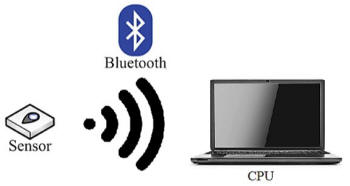
My contribution in this project has been the development of a system for arrhythmia detection and classification; my role was that of corresponding researcher. The electrocardiogram signal was captured through electrodes with the help of an acquisition card, and both the signal processing and the graphical user interface were programmed in Python. The R peaks were detected with the Hilbert transform and adaptive thresholds. The R wave is one of the most important sections of the QRS complex and has an essential role in the diagnosis of heart rhythm irregularities.

The performance of the system was tested using standard ECG waveform records from the MIT-BIH arrhythmia database. In addition, tests were carried out using the sensors for real-time data processing.
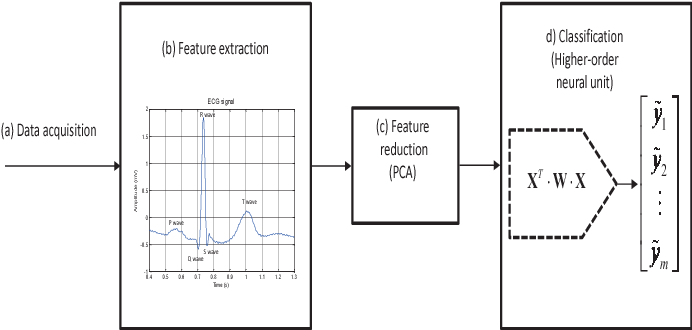
Classification pipeline: (a) data acquisition, (b) feature extraction from the ECG signal, (c) feature reduction with PCA and (d) classification with a higher-order neural unit
Detection and classification pipeline: acquisition, feature extraction, PCA and higher-order neural unit
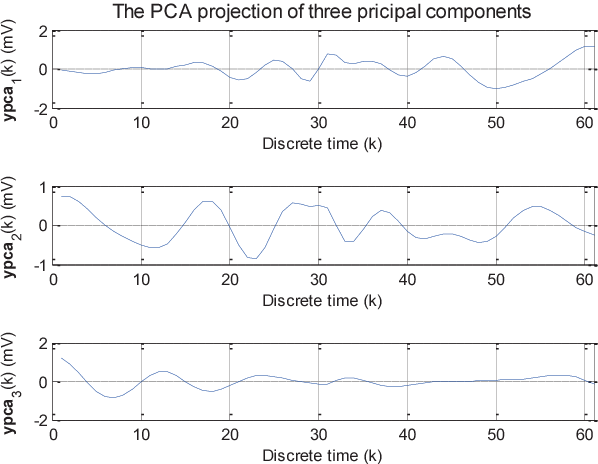
Plots of the ECG features projected on the first three principal components over discrete time
The PCA projection of three principal components

More information: Arrhythmia classification · Signal Processing.